
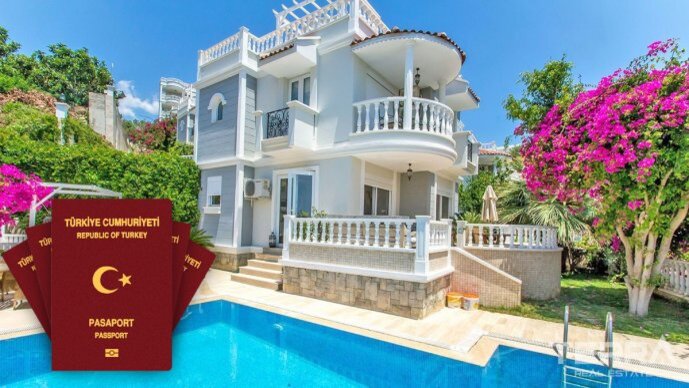
Turkey provides an exceptional citizenship route for qualifying foreign investors, including foreign nationals who acquire eligible real estate meeting the required investment threshold.
As of 2026, the minimum property investment amount for this route is USD 400,000 or the equivalent in foreign currency.
The property must also be registered with the required restriction stating that it will not be sold for at least three years.
Meeting the investment amount alone should not be treated as an automatic guarantee of citizenship. The property transaction, payment documentation, land registry procedures and citizenship application must comply with the applicable rules, and exceptional citizenship remains subject to the official application and decision process.
For international buyers specifically interested in citizenship, the property should therefore be evaluated for eligibility before the purchase is completed.
The current minimum qualifying real-estate investment is USD 400,000 or its equivalent in foreign currency.
Official Turkish investment information confirms that foreign natural persons may qualify through acquisition of property worth at least USD 400,000, provided the required restriction against sale is entered in the title deed for at least three years.
This is an important distinction because older websites and articles may still refer to the previous USD 250,000 threshold.
That amount is outdated for new property-based citizenship applications.
International buyers researching Turkish Citizenship by Property Investment should therefore make decisions using the current USD 400,000 threshold and current transaction requirements rather than historical figures.
A qualifying property cannot simply be purchased and immediately resold after the citizenship application.
The required declaration and title-deed restriction must state that the property will not be sold for a period of three years.
The three-year requirement is therefore a fundamental part of the investment structure.
A buyer should take this holding period into account when selecting the property.
A property purchased for citizenship should still make sense as a real estate investment, residence, holiday home or long-term asset rather than being selected solely because its asking price exceeds the threshold.
No.
Purchasing real estate worth USD 400,000 does not mean that Turkish citizenship is automatically issued at the Tapu office.
The property purchase is the investment basis for an exceptional citizenship application.
The competent authorities must establish that the relevant investment conditions have been satisfied, and the citizenship process follows separately.
Turkey's Citizenship Law provides for exceptional acquisition subject to the applicable statutory conditions and decision of the President, including the requirement that the applicant has no condition constituting an obstacle regarding national security and public order.
For this reason, marketing language such as "buy this property and citizenship is guaranteed" should be treated cautiously.
A property can potentially satisfy the investment criteria, but citizenship itself is an official legal process.
The investment route is not necessarily limited to one property.
Official Turkish investment guidance has confirmed that multiple properties can be used in a citizenship application where the applicable requirements are satisfied and the qualifying value is reached.
This can provide flexibility for an investor who prefers, for example, two apartments rather than one larger villa.
However, the properties and transactions must satisfy the citizenship rules.
Buyers should therefore structure the acquisition for citizenship purposes before completing the transactions rather than attempting to reorganise unsuitable purchases afterwards.
Official investment guidance has also stated that acquisition of a share in a property may qualify where the value of the acquired share itself meets the applicable minimum threshold and the other requirements are satisfied.
This does not mean that every shared-ownership arrangement is automatically suitable.
Ownership structure, qualifying value and transaction documentation need to be considered together.
For most international buyers, a straightforward ownership structure can also make the property easier to understand and manage.
Citizenship-focused buyers can encounter both completed properties and new-build opportunities.
For a completed property with an existing title deed, the acquisition can be structured around the qualifying purchase and required title-deed restriction.
There is also an official route involving a notarised promise-to-sell agreement for qualifying properties where condominium ownership or construction servitude has been established, subject to the required amount being paid in advance and the appropriate three-year non-transfer/non-cancellation undertaking being annotated in the land registry.
The correct route depends on the legal status of the property.
A buyer should therefore not assume that every off-plan project advertised at more than USD 400,000 is automatically suitable for citizenship.
One of the most important practical rules is to check the proposed transaction before making a substantial commitment.
A property's advertised selling price alone does not establish citizenship eligibility.
The property itself, seller, ownership history, transaction structure, official valuation requirements, payment records and land-registry conditions can all be relevant.
The citizenship route has additional compliance requirements beyond an ordinary property purchase.
This is why an investor should state from the beginning that the acquisition is intended for a citizenship application.
The property and transaction can then be examined from that perspective before completion.
Property value is a central part of the citizenship process.
Buyers should not assume that an owner's or developer's asking price is automatically the value that will be accepted for citizenship purposes.
The applicable official valuation and land-registry requirements must be satisfied.
This is particularly important when a property is marketed at a price only slightly above the minimum threshold.
A buyer who intends to rely on the property for citizenship should therefore leave sufficient room for proper verification rather than basing the entire strategy on an unverified marketing valuation.
A citizenship property purchase should have a clear and traceable payment structure.
Cash handed informally to a seller should not be treated as equivalent to properly documented transaction payments.
Banking records and other required payment evidence form an important part of demonstrating that the qualifying investment has actually been made.
The buyer should know the seller, receiving bank account, agreed purchase price and purpose of each transfer.
This is also important from a general property-security perspective, regardless of citizenship.
Foreign buyers must also take Turkey's foreign-currency rules for property acquisitions into account.
The applicable procedure involves the required foreign currency being sold through a bank and documented through the Currency Purchase Document known as Döviz Alım Belgesi or DAB before the relevant Tapu procedure.
For a citizenship-focused transaction, the banking, DAB, payment and Tapu stages should therefore be coordinated rather than handled independently at the last minute.
Our Foreign Currency Exchange for Property in Turkey guide explains the DAB procedure separately.
When a completed property is acquired under the citizenship route, the required declaration concerning the three-year holding period is recorded as part of the land-registry process.
This restriction is not simply a private promise between buyer and seller.
It forms part of the official citizenship investment structure.
Buyers should therefore understand that a citizenship-qualified property has a different short-term exit profile from a property purchased without this restriction.
If there is a possibility that the investor may need to sell the property quickly, that should be considered before choosing the citizenship route.
After the qualifying property procedures have been completed, the investment needs to be officially established for the citizenship process.
The competent authorities issue the relevant certificate of eligibility when the property investment requirements are confirmed.
The citizenship application then continues through the relevant residence and citizenship procedures.
The property purchase and citizenship decision should therefore be understood as connected but separate stages.
A Turkish residence permit and Turkish citizenship are not the same thing.
Property ownership can be relevant to different immigration routes, but each has its own legal basis and requirements.
For example, the current property-ownership short-term residence-permit route has its own conditions, including the applicable residential-property value requirement.
The citizenship-by-investment route instead uses the qualifying investment criteria described in this guide.
Buyers interested only in residence should therefore read our Residence Permit in Turkey by Property Ownership guide rather than assuming that the citizenship threshold applies to every residence application.
Likewise, purchasing an ordinary residential property does not automatically create a right to Turkish citizenship.
Exceptional citizenship legislation also addresses the foreign spouse and certain children of qualifying applicants within the relevant legal framework.
However, family structure and eligibility should be checked according to the applicant's individual circumstances.
Marriage documentation, birth records and other civil-status documents may be required during the citizenship procedure.
Foreign documents may also require the appropriate authentication and Turkish translation depending on their origin and use.
Families should therefore prepare civil documents early rather than waiting until the property purchase has already been completed.
International investors do not necessarily need to perform every property procedure personally.
Certain property transactions may be completed through a properly authorised representative where the power of attorney contains the required authority.
Official Turkish investment guidance also recognises the possibility of using a proxy for property acquisition connected with exceptional citizenship where this authority is clearly stated.
The scope of the power of attorney is therefore particularly important.
A generic document should not automatically be assumed sufficient for a citizenship-related property transaction.
Our Power of Attorney for Property in Turkey guide explains how Turkish and foreign-issued powers of attorney can be structured for property procedures.
A citizenship investor should still approach the purchase as a property buyer.
The investment threshold should not become the only selection criterion.
Location, construction quality, rental potential, resale market, property type, maintenance costs and lifestyle value remain important.
A well-selected property can serve two purposes: satisfying the qualifying investment requirements while also functioning as a useful long-term real-estate asset.
A poorly selected property does not become a good investment simply because it qualifies for a citizenship application.
Antalya is one of Turkey's most important international residential markets.
Buyers considering Property For Sale In Antalya for citizenship can choose from different property types and neighbourhoods depending on budget and intended use.
Some buyers prioritise a permanent home, while others prefer a modern apartment, villa or investment property.
Because citizenship-focused acquisitions are normally held for at least three years under the required restriction, location and future marketability deserve particular attention.
The buyer should ask whether the property would still be attractive without the citizenship benefit.
That is a useful test for investment quality.
Belek can be particularly attractive to investors seeking villas, holiday homes and properties associated with an international golf destination.
A buyer considering Belek Property may combine the citizenship objective with personal use, golf holidays or longer-term property ownership.
Properties near established residential areas, town amenities and golf infrastructure can offer a different profile from city-centre apartments.
For buyers specifically interested in Golf Property In Belek, the property should still be evaluated according to its individual characteristics, location and legal eligibility rather than relying only on a citizenship marketing label.
Kadriye can also provide relevant villa and residential opportunities within the wider Belek market.
The citizenship programme can sometimes lead buyers to focus too heavily on the threshold.
A property should not automatically command an inflated price merely because it is advertised as "citizenship eligible."
Buyers should compare the property with realistic market alternatives and understand what they are purchasing.
The goal should be to satisfy the legal investment conditions with a genuinely appropriate property, not to sacrifice normal investment discipline.
Independent valuation and market comparison are particularly useful where the asking price appears substantially different from comparable properties.
The three-year citizenship restriction concerns disposal of the qualifying property.
It should not automatically be interpreted as a general requirement that the owner personally occupy the property throughout the entire period.
Depending on the property and the owner's plans, rental use may be considered subject to the laws and regulations applicable to that type of rental activity.
Short-term tourism rentals in particular have their own regulatory requirements in Turkey and should be evaluated separately.
Citizenship eligibility should therefore not be confused with permission to conduct every type of rental activity.
Property is not the only investment route available under Turkey's exceptional citizenship framework.
Current official investment information also lists alternatives including qualifying fixed-capital investment, bank deposits, government bonds, qualifying investment-fund shares, employment creation and certain private-pension investments.
Most of these financial investment routes currently use a USD 500,000 threshold or equivalent foreign currency, while the property acquisition route uses USD 400,000.
For a real-estate buyer, however, the property route has the advantage that the qualifying capital is invested in a tangible asset that may also serve residential, holiday or investment purposes.
International buyers sometimes begin by searching for "citizenship properties."
A better approach is to combine legal eligibility with normal property-selection criteria.
First determine the location, property type and investment profile that make sense.
Then confirm whether suitable properties and the proposed transaction can satisfy the current citizenship requirements.
This reduces the risk of purchasing an unsuitable property simply because citizenship was used as the main sales message.
A citizenship-focused property purchase should be treated as a coordinated legal and real-estate transaction.
The buyer identifies a suitable property, verifies its legal and investment suitability, confirms that the qualifying value and transaction conditions can be satisfied, structures and documents the payment correctly, completes the required foreign-currency and Tapu procedures, places the required three-year restriction and proceeds through the official eligibility and citizenship application stages.
The current minimum property investment is USD 400,000, but the threshold is only one part of the process.
The final citizenship decision remains an official government process under Turkish citizenship legislation rather than an automatic consequence of buying real estate.
International buyers who are still researching the overall purchasing process can begin with our Buying Property in Turkey guide, review the Foreign Currency Exchange for Property in Turkey and Power of Attorney for Property in Turkey guides where relevant, and then compare suitable Property For Sale In Turkey according to their investment and lifestyle objectives.

Using a Power of Attorney to Buy Property in TurkeyInternational buyers do not necessarily need to be physically present in Turkey for every stage of a property transaction.A properly prepared power o...